Samsung planning to integrate Perplexity on upcoming Galaxy phones

Samsung is diversifying its agents, and hints of more of them in the future. (Picture: Samsung, manipulated)
8 in 10 users use more than one AI agent, Samsung’s research has found. So they are bringing in one more of them to their coming Android phones.

Galaxy AI will in the future act more as a conductor, shoveling tasks to the best agent, rather than as a gatekeeper serving tasks to a single one, says Won-Joon Choi, President, Chief Operating Officer at Samsung Electronics:

— Galaxy AI acts as an orchestrator, bringing together different forms of AI into a single, natural, cohesive experience.

Continue reading “Samsung planning to integrate Perplexity on upcoming Galaxy phones”

Anthropic finds most agent use in software, with users interrupting often

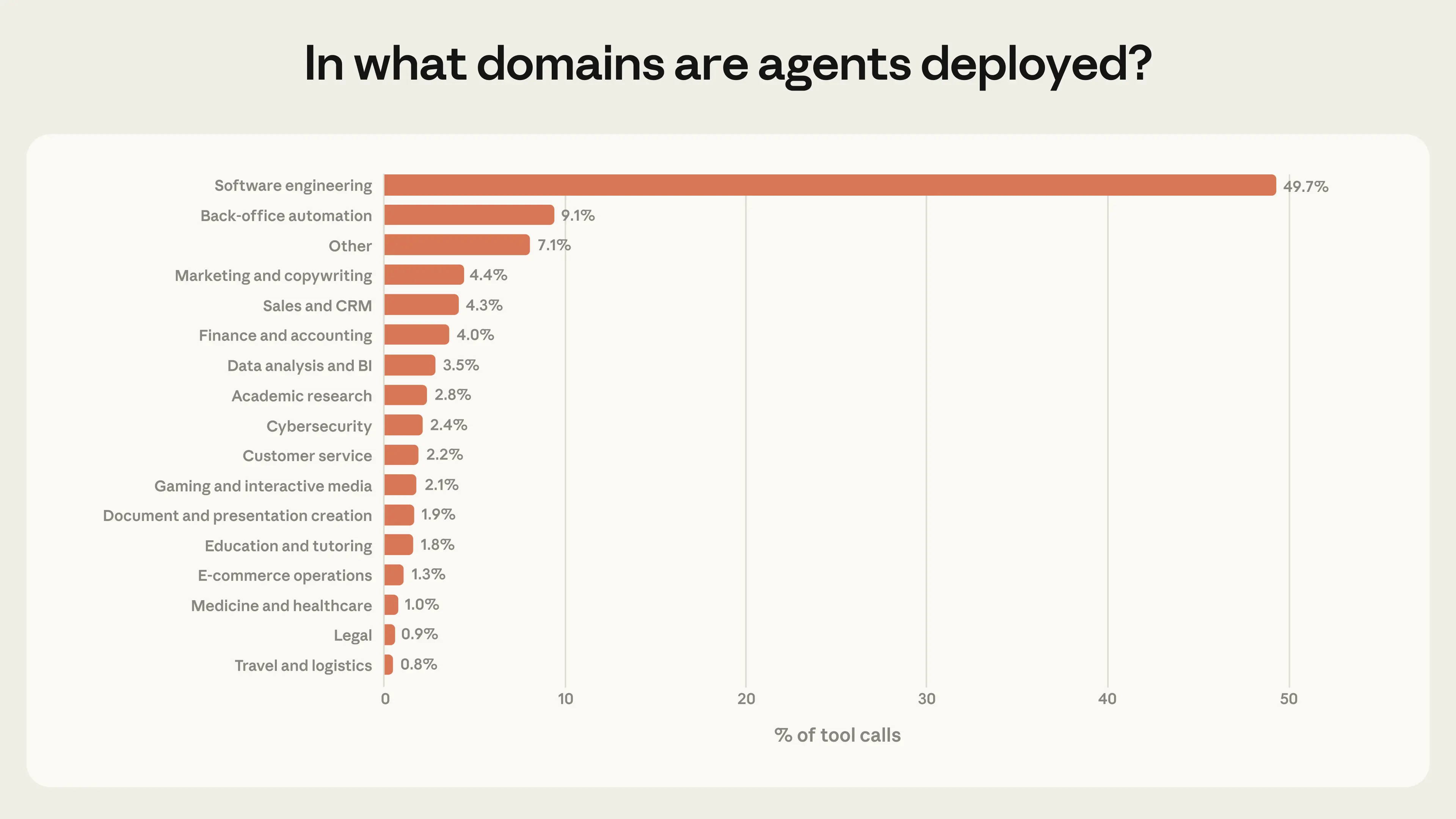
Anthropic’s agents are overwhelmingly used for coding, but is also making inroads elsewhere. (Picture: Anthropic)
The AI lab has analyzed millions of human-agent interactions with Claude Code and their API. Unsurprisingly, they found most of the usage to be for coding work, with uptake in other sectors lagging far behind.

They discovered that while most of the usage is for one-shot code snippets, more users are letting Claude Code work autonomously, up to 45 minutes at a time after three months.

Continue reading “Anthropic finds most agent use in software, with users interrupting often”

The hundreds of billions in AI investments flowing into India

The Indian AI Summit was a great success for the country, securing hundreds of billions in investments. (Picture: AI Impact Summit)
After the conclusion of the Indian AI Impact Summit, the chips are in on massive investments into data centers in the country.

It’s OpenAI’s second biggest market and looks set for a massive buildout of AI capacity in the years leading up to 2035.

Adani dishing out the dollars
First out is the Adani Group, pledging $100 billion to build data centers by 2035, which they expect to trigger «an additional $150 billion in secondary investments.» This should scale their data center portfolio from 2 gigawatts to 5 GW.

Continue reading “The hundreds of billions in AI investments flowing into India”

OpenAI’s first device will reportedly be a pocket-sized AI speaker, due in 2027

Does the world really need another smart speaker? Ive and Altman certainly think so. (Picture: screenshot)
After buying former Chief Apple Designer Jony Ive’s Io design lab in May, 2025, Altman and Ive have been teasing a breakthrough hardware device said to be something to take a bite of — and speculation has abounded.

Now The Information (paywalled) is citing sources from an all hands meeting at OpenAI touting an early prototype of a smart speaker.

Continue reading “OpenAI’s first device will reportedly be a pocket-sized AI speaker, due in 2027”

Big brands are hitting ChatGPT ads — but only show in 0.8% of responses

Ads from Expedia, Qualcomm, Best Buy, and Enterprise Mobility have started appearing in relation to ChatGPT queries, Adweek reports.

The «early tests» have been ongoing since February 9th, and OpenAI is asking advertisers to pay a $200,000 minimum to join in.

— We believe ads play an important role in continuing to support broad access to AI, Asad Awan, ads and monetization lead at OpenAI, tells Adweek in a statement.

— By working closely with partners in this pilot, we’re able to thoughtfully test new ad experiences, he continues.

The advertising intelligence platform Adthena ran a test on over 500 prompts in ChatGPT and found ad placements on only 0.8% of responses, according to Adweek.

Adthena also found ads were clearly labeled, sometimes triggering on the first prompt, that OpenAI is surpisingly focused on privacy and user control, and that the text format seemed familiar and trusted.

Read more: Adweek, and Adthena on LinkedIn.

Google announces Gemini 3.1 Pro: «a step forward in reasoning»

Expect more, rapid one-point releases from the frontier labs going ahead. (Picture: Google)
The new model is a «smarter, more capable baseline for complex problem-solving,» Google says.

It’s the new leader on the benchmarks, almost solving ARC-AGI with 98% and hitting 77% on ARC-AGI 2, the problem solver benchmark, more than doubling Gemini 3’s results.

It also scores 44.4% on Humanity’s Last Exam, which is the best yet and definitly makes it the new state-of-the art.

Gemini 3 Pro was only released last November, so this new point-release might well signal where frontier labs are heading next — incremental updates every few months rather than full blown giant steps every six months to a year.

Gemini 3.1 Pro is rolling out today «in preview» to Pro and Ultra plans, and it’s also in NotebookLM for those users. Developers should also get a taste soon. Pricing is the same as Gemini 3 Pro.

Read more: Google’s announcement, launch thread. See also 9to5Google, Ars Technica and TechCrunch. Discussion on r/Singularity.

Faux pas at Indian AI summit as Amodei and Altman refuse hands

Whoever thought it was a good idea to have these guys hold hands? (Picture: Government of India Press Information Bureau)
In what was expected to be a show of unity with Indian PM Narendra Modi on stage, AI leaders were asked to hold hands in solidarity.

Anthropic CEO Dario Amedei and OpenAI CEO Sam Altman were, however, for some reason, placed right next to each other on stage — and the acrimonious rivals promptly refused the gesture.

Continue reading “Faux pas at Indian AI summit as Amodei and Altman refuse hands”

Fei-Fei Li’s World Labs raises $1 billion for spatial intelligence, world models

Marble can make intricate 3D worlds from prompts or pictures, and Autodesk wants in. (Picture: World Labs)
As «the godmother of AI’s» world-building Marble model is taking off, some say World Labs has hit a $5 billion valuation, according to Reuters.

Most notably, they collected $200 million in funding from Autodesk — which makes 3D CAD software in a somewhat overlapping fashion.

They will now officially become advisors to World Labs, and are starting up a collaboration, writes TechCrunch.

— You might want to take an object that you’ve designed in our [platform], and put it in a context that you create through one of [World Labs’] prompts, says Daron Green, Autodesk’s chief scientist, to the website.

World Labs themselves have not provided a valuation from the funding round.

Read more: Autodesk’s announcement, World Lab’s announcement. More detail from TechCrunch, Reuters.

Google launches custom music generation in Gemini with Lyria 3 model

Gemini can now make you thirty seconds of music based on prompts or photos, and will even use Nano Banana for custom art for it.

They say the feature is for fun and games, and very specific music requests that can be personal, like making a tune about your mum’s home cooked plantains.

Continue reading “Google launches custom music generation in Gemini with Lyria 3 model”

Nvidia strikes «multi-year strategic partnership» with Meta for AI chips

Likely costing a significant measure of Meta’s capital expenditures, the deal is expected to be in tens of billions dollars or more.
Both Meta and Nvidia are announcing a long-term, multi-generational strategic partnership today — without mentioning the price.

Meta, already a top customer for Nvidia, will use their chips in a «large-scale deployment» to build out data centers «optimized for AI training and inference,» they say.

The cost of the deal will likely run into the tens of billions of dollars or more, CNBC reckons, and includes access to future chips as well as the current Blackwell and Vera Rubin generations.

— We do expect a good portion of Meta’s capex to go toward this Nvidia build-out, chip analyst Ben Bajarin of Creative Strategies tells CNBC.

Reuters notes that Meta is likely one of the top three customers accounting for more than half of Nvidia’s sales.

Read more: Meta announcement, Nvidia announcement. Writeups on CNBC, Reuters and The Verge.

Anthropic launches Claude Sonnet 4.6, «most capable yet»

Models are coming at breakneck speed from Anthropic. (Picture: Anthropic)
Sonnet 4.6 comes less than two weeks after Opus 4.6, and performs almost as well at the same old cost of $3/$15 per million tokens.

It features upgrades across coding, computer use, long context reasoning, agent planning, knowledge work and design, Anthropic says.

It is now the default model for the Free and Pro plans, and has a context window of 1 million tokens.

The model performs best in class for Agentic financial analysis and Office tasks on benchmarks, but it otherwise lags slightly behind Opus 4.6.

— Sonnet 4.6 offers strong performance at any thinking effort, even with extended thinking off, Anthropic writes.

Also, Claude in Excel now supports MCP connectors, so you can now import data and use everyday tools without ever leaving Excel.

Read more: Anthropic’s announcement, more on Axios, TechCrunch, Mashable.

Ireland enacts basic income for artists, says it creates more than they spend

Basic income schemes are closely watched in case AI supplants jobs at scale. (Picture: Images Money, CC BY 2.0)
After a pilot scheme lasting from 2022-25 with basic income for artists, the Irish Government is moving to make it permanent.

2,000 eligible artists will be randomly selected to get €325 per week, after the pilot found that for every €1 invested, society received €1.39 in return.

It’s not enough to live on, but it is enough to see artists through their arts without taking on side gigs and onerous secondary jobs.

During the pilot, artists reported they had more time for their art, produced more work, experienced a boost in well-being, had greater life satisfaction and that it reduced their anxiety.

— The BIA [Basic Income for Artists] pilot research has consistently demonstrated both the positive impact it has had on those in receipt of it and how difficult it is to work as an artist in Ireland, says Culture Minister Patrick O’Donovan.

This is the first such officially enacted Government-based basic income program in the world, O’Donovan says.

Read more: Irish Government announcement, writeups on IrishCentral and The Guardian.

Britain is launching public probe into children’s use of AI chatbots

It’s for the kids; restricting chatbot harm to children is a high priority for the UK. (Picture: generated).
After starting an investigation against x.com and Grok for creating sexualized images, the UK government is launching a new «consultation» into how chatbots interact with children.

— I am concerned about these AI chatbots… as is the prime minister, about the impact that’s having on children and young people, Technology Secretary Liz Kendall says, according to Reuters.

The first order of business is to make sure the chatbots follow the Online Safety Act, which doesn’t cover one-to-one interactions with chatbots as of today, Reuters says. This is mainly because it was enacted before they were on the radar, and this step will make it possible to regulate them like social media.

The wider consultation will «include examining restrictions on children’s use of AI chatbots,» the government says, and will be conducted over the coming months, ending in a set of proposals by June, 2026.

Read more: UK government presentation, and Reuters, CNBC.

OpenAI introduces Lockdown Mode and Elevated Risk protections

Only secure access is granted in the new Lockdown Mode. (Picture: OpenAI)
ChatGPT can be useful, but also carries some risk — especially when it’s browsing the web or using apps.

That’s why OpenAI is now launching «an advanced, optional setting for higher risk users.»

The idea is to disable tools an adversary might use to «to exploit to exfiltrate sensitive data,» such as prompt injection attacks in files or on the web.

When using Lockdown Mode, web use is limited to cached content only, and no live network access is available outside of OpenAI’s «controlled network»

Most people will never need this feature, OpenAI says, but it might be useful for corporate execs, security teams, journalists and officials.

OpenAI is also launching an «Elevated Risk»-setting, that lets users fine-tune network access for Atlas and Codex.

Both features are coming to users «in the coming months.»

Read more: OpenAI’s announcement.

Anthropic won the Super Bowl ads war

Anthropic’s ad was about ads in chat responses, and it seems to have landed. (Picture: Screenshot)
While the AI Super Bowl ads had generally lower engagement than others — there was a battle over mindshare brewing between them.

Anthropic won that battle, and saw a jump in daily active users of 11%, CNBC writes, quoting BNP Paribas. In comparison, ChatGPT jumped 2.7% and Gemini added 1.4%.

Anthropic also won the battle over social media engagement, with more positive posts (25.5%) after their ad was shown than OpenAI (16.3%) — even though OpenAI led with 25K posts to Anthropic’s 10K.

Measuring through Instagram, OpenAI’s ad scored a 44% positive sentiment from 3,829 engagements on its post, while Anthropic scored 41% on 3,738 mentions, far behind the likes of Pepsi’s 33K mentions.

Read more: CNBC, Business Insider and Digiday.