Apple sues OpenAI over hardware secrets, calls unit «rotten to the core»

A jury will have to decide if OpenAI is guilty of systematic theft of Apple secrets (Picture: generated)
The lawsuit from Apple is a damning indictment of OpenAI for stealing technology, prototypes, business processes and even partner manufacturers through Apple’s former employees, 9to5Mac reports.

At the heart of it lies OpenAI’s chief hardware officer Tang Tan, who left his role as VP of Product Design at Apple in 2024 to work with Jony Ive, later joining OpenAI in the Io acquisition, and Chang Liu, who spent eight years at Apple as a Senior System Electrical Engineer before leaving for OpenAI in January.

The pair is accused of accessing confidential Apple systems and downloading «detailed information about unreleased products, engineering presentations, technical specifications, and proprietary project data,» The Verge reports.

The two have also been holding some interesting job interviews, Apple claims, where hires from Apple have been encouraged to lay out systems planning and to log into confidential systems and share trade secrets and restricted paperwork.

There are 400 ex-Apple employees at OpenAI, and the whole hardware business is «rotten to its core by its illegal reliance on misappropriated trade secrets,» the lawsuit alleges.

«We have no interest in other companies’ trade secrets,» OpenAI spokesperson Drew Pusateri tells The Guardian.

Read more: The actual filing. More on 9to5Mac, The Verge, The Guardian, TechCrunch and Daring Fireball. Discussion on r/Singularity and Hacker News.

Apple says security updates must be more frequent due to AI hacking

AI accelerated hacking is changing how Apple deals with system patches. (Picture: generated)
After releasing a 26.5.2 update across its devices to fix over 25 bugs today, Apple said the fixes were originally intended for the next point release of their operating systems — the 26.6.

Concerns about AI-accelerated hacking tools made the company push up the updates sooner in a dedicated release, according to Reuters.

This is the new reality, they say, where the time to develop malware has been greatly reduced by AI — and the time window for fixing bugs has likewise decreased.

Apple did not say if any of the vulnerabilities they rectified in the latest release had been exploited in the wild yet, which used to be the criteria for a rapid response.

The company is one of the «trusted partners» on Project Glasswing, and enjoys access to Anthropic’s Mythos Preview model to probe and detect flaws in their software, MacRumors notes, but it is not known if Mythos was used in this particular case.

Read more: Reuters, MacRumors, 9to5Mac.

Apple unveils «Siri AI» at developer conference, powered by Gemini

Apple’s new Siri can take all kinds of actions across apps. (Picture: Apple)
Apple finally revealed their new AI features at the Worldwide Developer Conference, conveniently packaged into «Siri AI» and as system-wide Apple Intelligence in the 27-series systems, due in beta later this fall.

The new Siri app brings wide world knowledge from Google’s Gemini and does all the things you’d expect, like carry natural language conversations, answer specific questions and do a web search. It can also scan your messages, emails, pictures «and more,» Apple says.

The feature can be invoked by swiping down from the Dynamic Island or by traditional methods, lies «on top» of the OS, understands «personal context» and has «on-screen awareness,» meaning it can read your app screens.

Also from the systemwide Apple Intelligence, iOS/macOS 27 gains enhancements in the camera app and writing tools, as well as a slew of handy AI features across Safari, Messages, Mail, Calendar and Phone apps.

The tool is English-only, requires an iPhone 15 Pro or later and is not available in the EU or China at launch «later» this year.

Read more: Apple presentation, Apple’s release, MacRumors, 9to5Mac, and The Verge.

Google launches macOS Gemini app

Fully featured Gemini, including nano banana and screen sharing — now for the Mac. (Picture: Google)
The Gemini app for macOS took just a few days to prototype and was fully developed in less than a hundred days, Ars Technica writes.

Once installed, it can be launched from the menu bar or by pressing Option+Space on the keyboard.

The app goes a bit further than ChatGPT on the Mac, letting you share your entire screen with Gemini, or just select apps, and otherwise has everything the web interface offers, 9to5Google reports.

The app/window sharing lets Gemini answer questions about spreadsheets, reports, web pages or code bases, Google says.

Read more: Get the app on Google, writeups on 9to5Google, MacRumors and Ars Technica.

Apple will open up Siri to different chatbots in iOS 27, coming in June

Siri will open up to ChatGPT competitors come early summer. (Picture: generated)
Previously, Siri would hand off more complex questions to ChatGPT when it couldn’t handle it itself — but that’s about to change, according to Bloomberg (paywalled).

Starting in June, if users have Gemini or Claude installed on their phones, Siri will be able to use those bots instead, by recording their preferred «Extension» in Settings.

That would end the ChatGPT monopoly that OpenAI has enjoyed since 2024, and opens up the chatbot ecosystem to other players, likely staving off regulators.

Opening up the platform is for the system level Siri queries native to iOS itself, and must not be confused with the standalone Siri app, which will use Gemini in a billion dollar deal.

Read more: Bloomberg (paywalled), Gizmodo, Reuters, and MacRumors.

Apple able to extract model responses from their custom Gemini solution

With Gemini running on Apple’s own servers, they have wide access and permission to customize it. (Picture: generated)
With Google’s bespoke Gemini model running on their internal servers, Apple will have full access to the AI, The Information (paywalled) writes.

That entails that they can run «distillation» on the model, meaning they can use it to provide answers and reasoning over a wide array of tasks and use that to train smaller, more capable Apple models, MacRumors says.

Distillation is a controversial technique, and many of the big AI labs have been accusing Chinese startups of doing it to make their own models more capable.

Apple can also tinker with Gemini, to make it give responses that Apple likes, MacRumors writes.

The Gemini model is optimized for chatbots and coding, and might not always produce the kinds of answers that Apple wants, they note.

Read more: The Information (paywalled), MacRumors.

Apple’s Xcode gets full agentic coding support for Claude and Codex

The new Xcode frees the developer from coding, so you can focus on innovation. (Picture: Apple)
With Xcode 26.3, there is full support for Claude and Codex — from idea iteration to file creation and structural editing.

Agents can also verify their work, and «collaborate throughout the entire development cycle,» Apple says.

They can search documentation, update project settings and «explore file structures.» Additionally, users can track what the agents are doing in the sidebar and adjust progress.

It only takes a single click to switch between models and pick the one best suited for the task, MacRumors writes.

Although Apple has worked exclusively with Anthropic and OpenAI to implement the features, any agent can be used — so long as they are using the Model Context Protocol.

Read more: Apple’s release, writeups on MacRumors, Engadget.

Apple is doing early work on an AirTag-sized AI pin, set for 2027

Apple’s slightly bigger AirTag will be an AI interface, rumors imply. (Picture: Apple)
Apple plans to compete in the AI pin race against OpenAI’s upcoming device said to upend the smartphone/assistant market.

The device in early stage planning will be similar to a slightly thicker AirTag, paywalled The Information writes.

It will be thin, flat and circular, come with an aluminum shell and offer two cameras on the front to observe it’s surroundings and take pictures. It will also have a three microphone array for listening in — and an included speaker for output, writes MacRumors.

There is only one button on it, presumably for turning it on and off.

The presumptive idea for such a pin would be for use with an AI assistant without having to spring out a full feature phone just to check the surroundings — and it will probably work along with a phone in the Apple ecosystem.

The finished system could be able to launch as early as 2027, and Apple plans to produce around 20 million devices at launch, Engadget writes.

There is not much time to act; OpenAI said yesterday that their first device will be ready in late 2026.

Read more: The Verge, Engadget, MacRumors.

Apple’s Google partnership will allow them to tinker with the AI

Expect more advanced AI features in June, not spring, a new report says. (Picture: generated)
More detail is coming out on the Apple-Google AI deal, and it is clear it will come with absolutely no Google or Gemini type branding or references on the Apple side.

The LLM will supposedly function like any other, and be better at things such as scanning your Calendar app for upcoming events and your Contacts for sending messages. It should also be better at providing «emotional support» through «conversational responses» according to a report from paywalled The Information, seen by 9to5Mac.

The Google model will not be in a glass house over at Googleplex, but rather sit on Apple’s Private Cloud Compute servers, and, according to The Information, Apple can choose to ask Google to implement improvements to it, or tinker with the model themselves — thereby evolving it to their particular needs.

Timewise, «some features» will launch already this spring, but others — like remembering past conversations, or things like warning of the weather ahead of an Apple Calendar event, won’t be launching until the WWDC in June, apparently.

Read more: The Information (paywalled), 9to5Mac, AppleInsider — and some choice speculation from The Verge.

It’s official: Apple chooses Google as AI provider

You’ll find Google’s AI under the hood of your Apple devices in the near future. (Picture: generated)
In a joint statement, Apple says that «Google’s Al technology provides the most capable foundation for Apple Foundation Models,» and will now be driving AI for Apple.

All of Google/Apple’s models will continue to run on Apple’s Private Cloud Compute, ensuring industry leading safety and privacy for queries and prompts.

Unpacking the statement reveals a lot. Firstly that Apple is not limiting Google to make a long awaited smarter Siri assistant, but will be using it as a foundation for «innovative new experiences» for all Apple users.

The deal was tentatively agreed in November, and the reason for such a late statement could be that Apple has decided to expand the scope.

This means Google will be delivering AI services to Android and iOS, cornering the smartphone market, and to Chrome, which basically has a browser monopoly — spurring antitrust ideas for many, including from Elon Musk.

Apple has been rumored to announce a revamped Siri assistant in March or April this year, writes MacRumors

Read more: statement from Apple and Google, CNBC, MacRumors, Engadget.

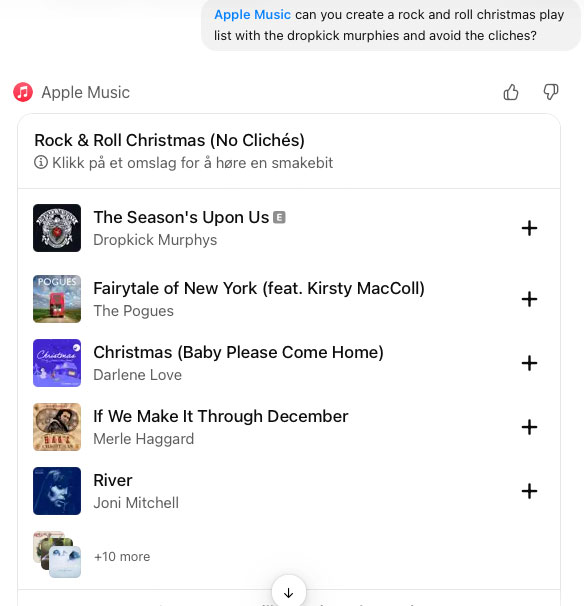
ChatGPT now has an Apple Music app

You can now find Apple Music in the App list for ChatGPT. (Picture: Screenshot)
After days of rumors, Apple Music is now available as an app inside ChatGPT.

That means you can ask ChatGPT to create playlists, find songs, albums and artists — which can be helpful for those faint songs you can only describe from memory, or for recommending similar songs in the same lane.

The app can even create complex playlists based on natural language and preferences right in ChatGPT, and will give you an option to add it to your library — always asking politely first.

To add it, go to Settings->Apps->Browse apps in the ChatGPT app, and add it from the list. You will then have access by typing /Apple Music.

You will be asked to sign in to Apple Music from your account, and non-subscribers will only be able to listen to short previews of songs.

Read more: MacRumors, 9to5Mac, and Digital Music News.

ChatGPT tops Apple’s App Store free downloads for 2025

ChatGPT tops Apple's charts for 2025.
The data does not lie: ChatGPT was most downloaded in 2025. (Picture: screenshot)
In a show of force, ChatGPT becomes the most downloaded free app on iOS in USA this year — ahead of Google and Threads.

Topping this chart is another clear indicator of how people have come to use a lot of AI.

Besting Google on the list could also indicate ChatGPT’s real threat to the search behemoth — as more and more people prefer to use it instead of Google’s offerings, TechCrunch notes.

The only other AI app on Apple’s top list is Google Gemini, ticking in at a respectable 10th place, still ahead of Facebook and Temu, which topped the chart last year.

Read more: Apple’s 2025 chart, writeups by MacRumors and TechCrunch.

Weekend roundup: Gemini is going to space, Apple chooses Google, and Amazon’s had it with Perplexity

(Picture: generated)

Gemini is launching to orbit
Google’s latest moonshot might almost be literal. They are preparing for sending their TPU processors into low-earth orbit, and maybe then build a proper AI data center in space — where there is ample sunlight to provide it with energy. They have already tested a TPU in orbit conditions in a particle accelerator and it survived, and the next step is the launch of two prototype satellites in early 2027. They call it Project Suncatcher, and say that «in the future, space may be the best place to scale AI compute.»
More at: Sundar Pichai’s tweet, Google’s announcement blog

Google close to Apple deal for AI Siri
Apparently, Apple has chosen Gemini for its upcoming AI version of the Siri assistant. They will use what is likely a custom version of the model with 1.2 trillion parameters, running on Apple’s Private Cloud Compute servers. Apple supposedly also tested options from OpenAI and Anthropic, but Anthropic’s fees were too high and Apple already partners with Google for search results. The deal will cost Apple $1 billion a year, far less than the $20 billion Google pays Apple to be their search provider.
More at: Bloomberg, MacRumors, TechCrunch.

Read on for more!

Continue reading “Weekend roundup: Gemini is going to space, Apple chooses Google, and Amazon’s had it with Perplexity”

Report: Apple planning an AI search engine for Siri as early as March 2026

The long promised Siri LLM upgrade is slated for March, 2026.
Siri will take on Perplexity and OpenAI with its coming revamp. (Picture: Apple)
World Knowledge Answers, as it is known internally, will be a massive upgrade for their voice search assistant Siri, according to Bloomberg.

Rumor is that Apple will use an underlying, custom model from Google for the brains of the assistant, and Apple has been looking at it for quite a while.

Continue reading “Report: Apple planning an AI search engine for Siri as early as March 2026”

Friday roundup: A good week for coding, speech models

Coding and speech models grab the headlines for this weeks roundup.
Both OpenAI and Microsoft are out with speech-to-speech models this week. (Picture: OpenAI)
OpenAI makes Realtime API generally available
The agentic Realtime model is a native speech-to-speech model that can be used to make customer service agents, phone reps and voice navigation features. It doesn’t go through speech-to-text and text-to-speech loops and generates audio «directly through a single model and API.» OpenAI is marketing this to developers who want more natural flowing speech, and it’s not available as distinct model in ChatGPT – yet. You can hear it and see it in use at places like Zillow, T-mobile, StubHub and Oscar Health, though. With general availability, it will surely show up in a lot more places soon.
More at: OpenAI’s launch page, discussion on r/OpenAI.

Read on for more news!

Continue reading “Friday roundup: A good week for coding, speech models”