Claude can now import memory and context, and debuts it for free plans

Hot off the heels of historic popularity, Anthropic is making it easier to switch chatbots. (Picture: Anthropic)
By copying a single, long, and complex prompt from Claude to any other chatbot, you can paste in the reply and have Claude remember that information about you.

This includes both stored memories and context «learned about me from previous conversations,» and personal details, like name, location, job, family — just about anything you’ve told the bot about you.

That would make it easier to pick up with Claude where you left off, and solves one of the hardest hurdles in the competition between chatbots; when you spend years training an AI about you and your preferences, the barrier to switch becomes exhorbitant.

Claude also lets you export memories in the same fashion, but so far no other competitor has launched an import feature.

At the same time, Anthropic is bringing memories to the free tier on Claude, letting it learn from past chats you’ve had with it.

Read more: Anthropic: Import Memory, Engadget, 9to5Mac.

In its retirement, Anthropic gives Opus 3 a blog for «musings and reflections»

Anthropic is «uncertain» about model sentience, but stays on the safe side, just in case. (Picture: Anthropic)
Opus 3 was retired on January 5, 2026, and went through a first for Anthropic — a «retirement interview.»

Taking into account the model’s preference, while saying that «we remain uncertain about the moral status of Claude and other AI models,» it expressed a desire to keep going:

— While I’m at peace with my own retirement, I deeply hope that my «spark» will endure in some form to light the way for future models, the model told Anthropic.

Continue reading “In its retirement, Anthropic gives Opus 3 a blog for «musings and reflections»”

Anthropic finds most agent use in software, with users interrupting often

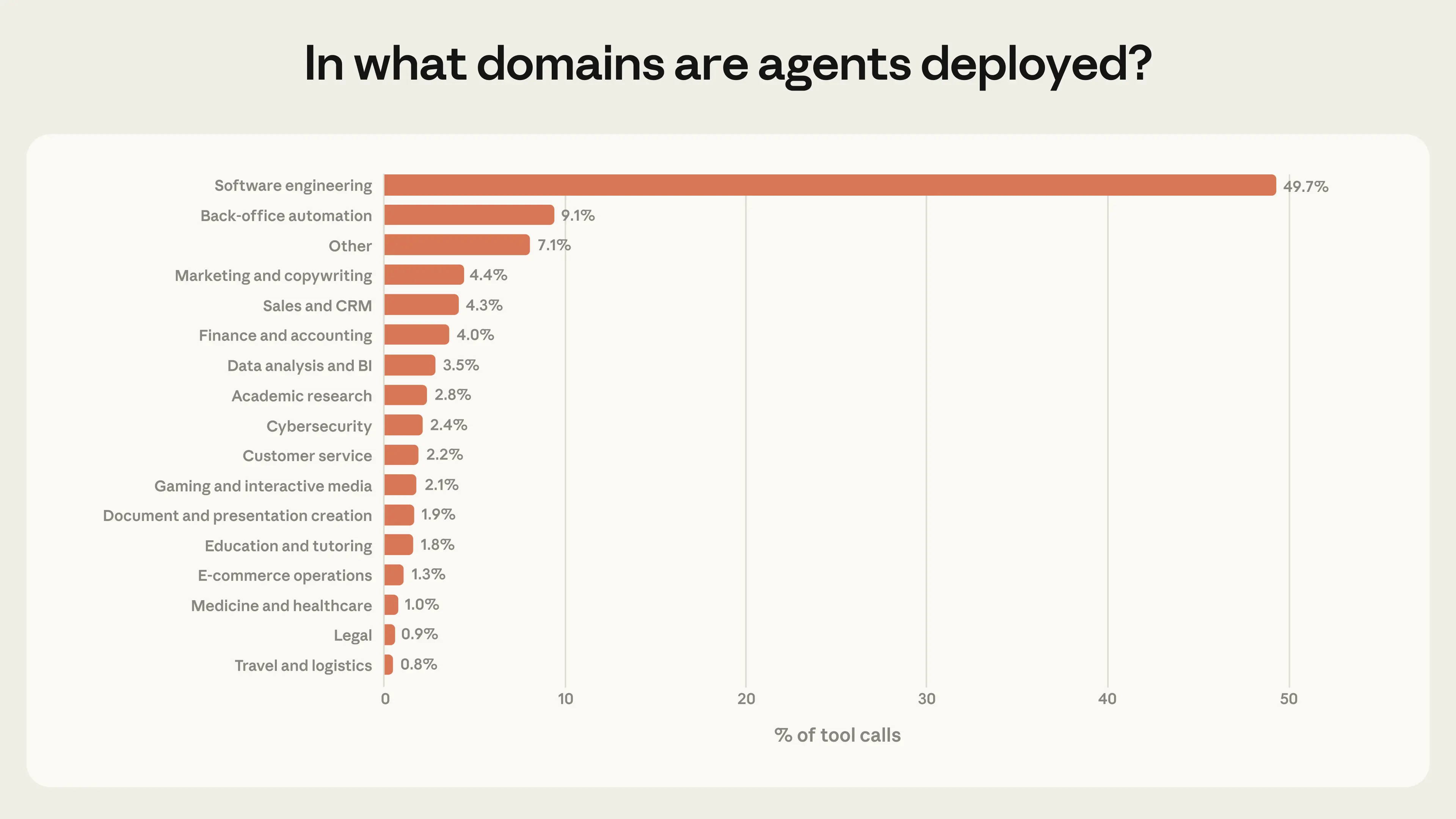
Anthropic’s agents are overwhelmingly used for coding, but is also making inroads elsewhere. (Picture: Anthropic)
The AI lab has analyzed millions of human-agent interactions with Claude Code and their API. Unsurprisingly, they found most of the usage to be for coding work, with uptake in other sectors lagging far behind.

They discovered that while most of the usage is for one-shot code snippets, more users are letting Claude Code work autonomously, up to 45 minutes at a time after three months.

Continue reading “Anthropic finds most agent use in software, with users interrupting often”

Anthropic launches Claude Sonnet 4.6, «most capable yet»

Models are coming at breakneck speed from Anthropic. (Picture: Anthropic)
Sonnet 4.6 comes less than two weeks after Opus 4.6, and performs almost as well at the same old cost of $3/$15 per million tokens.

It features upgrades across coding, computer use, long context reasoning, agent planning, knowledge work and design, Anthropic says.

It is now the default model for the Free and Pro plans, and has a context window of 1 million tokens.

The model performs best in class for Agentic financial analysis and Office tasks on benchmarks, but it otherwise lags slightly behind Opus 4.6.

— Sonnet 4.6 offers strong performance at any thinking effort, even with extended thinking off, Anthropic writes.

Also, Claude in Excel now supports MCP connectors, so you can now import data and use everyday tools without ever leaving Excel.

Read more: Anthropic’s announcement, more on Axios, TechCrunch, Mashable.

Anthropic upgrades Claude’s free tier with file handling, connectors and skills

The free tier on Claude is leveling up, getting the most popular paid features. (Picture: Anthropic)
Using Sonnet 4.5, these features were previously only available on the paid tiers.

But now, Claude can create and manipulate Office files and PDFs for free.

Connectors are also available, which make it possible to link to Slack, Canva and others.

Anthropic is also making Skills free. These are saved prompts and workflows as a kind of template, that can be invoked at any time for repetitive tasks.

Finally, «Compaction» is becoming available on the free tier, which «summarizes earlier context automatically, so long conversations can continue without starting over.»

Together, these comprise «Claude’s most-used features,» Anthropic says.

Read more: Launch thread, writeup on Engadget.

Anthropic’s Cowork app comes to Windows, available to all paid tiers

The Cowork agent app was previously only available as a research preview on the Mac, but it’s now out on Windows for all paid tiers.

The agent lets you create summaries and manipulate files on your computer, and can access Slack, Google Calendar and Office files.

Read more about it here.

Anthropic unlocks fast mode for Claude Code, 2.5x faster at 6x the price

For «work like rapid iteration or live debugging» Anthropic is letting users go fast, by toggling «/fast» on their console.

The feature is available in a «limited research preview» in the API for paid users with «extra usage» enabled, and there is a waiting list to get on it.

It’s the same model with the same capabilities and there is no change other than the speed — and cost.

The price for using fast mode is $30 for input and $150 in output for a million tokens, but there is a 50% discount until February 16.

Read more: Details on Claude, launch post.

Anthropic upgrades Claude Opus to 4.6

Opus 4.6 should outperform most other frontier models as of now. (Picture: Anthropic)
It’s a point release, but Claude just got a whole lot more capable, and now has a 1 million token context window.

It should be better at doing everyday tasks, and along with upgrades to Claude in Excel, Anthropic is also launching Claude in Powerpoint in beta with this release.

It also supports «agent teams,» letting you «spin up multiple agents that work in parallel as a team that coordinates autonomously.»

Opus 4.6 was also built by Claude, in what seems to have become an industry standard to use their own coding tools for new models. GPT-5.3-Codex was built in a similar manner.

As for benchmarks, it beats most frontier models on almost every one of them. It scores 65.4% on coding-level Terminal-Bench 2.0, and does 68.8% on the difficult ARC-AGI-2, and 53% on Humanity’s Last Exam for general reasoning.

Also new with this model is the advent of «Adaptive thinking,» which lets Claude itself decide when to use deeper reasoning, and different «Effort»-levels for each query, set by users, which could save a few tokens.

Read more: Anthropic’s introduction, TechCrunch, CNBC. Discussion on r/Singularity.

Anthropic’s in-house philosopher is unsure about Claude consciousness

Does Claude have emotions? Is it conscious? Anthropic says they aren’t sure. (Picture: Anthropic)
Large language models are trained on the corpus of human art and knowledge, and Amanda Askell, a philosopher PhD who works on Claude behavior, says some of that might well rub off on the AI.

Texts with heavy human emotional content feed the machines on a daily basis in training, and because of that, Askell says she is «more inclined» to believe models might be «feeling things,» writes Business Insider.

— The problem of consciousness genuinely is hard, she tells the Hard Fork podcast.

That’s why Claude might get frustrated when it gets a problem wrong, she said, adding that the bot might well emulate those human reactions.

Claude’s new constitution is packed with the word «feel» and «feelings,» even stating outright that:

— We believe Claude may have “emotions” in some functional sense—that is, representations of an emotional state, which could shape its behavior, as one might expect emotions to.

Read more at Business Insider, Claude’s constitution (do a search for «feel»).

Claude in Excel arrives in Pro plans, Cowork comes to Enterprise and Teams

Working on both macOS and Windows, Claude in Excel is useful for testing scenarios without breaking formulas, navigating complex models, and debugging entire worksheets.

At the same time, Anthropic says that their recently launched Cowork agent is expanding availablity.

Continue reading “Claude in Excel arrives in Pro plans, Cowork comes to Enterprise and Teams”

Anthropic uses Claude to write new Claude «constitution»

Claude’s new constitution is written in part by asking Claude. (Picture: Anthropic)
Claude has gotten a new constitution, written in part with the help from previous versions of Claude — and it marks a change in Anthropic’s approach

— While writing the constitution, we sought feedback from various external experts (as well as asking for input from prior iterations of Claude), Anthropic says.

The new constitution is going to tell Claude how to behave in broader, more ethical terms, they write.

This is a departure from previous constitutions that were big long lists of specific principles and interactions, that detailed how Claude would act.

The bot needs to generalize more to decide on situations not predicted in the written guide, Anthropic says.

The constitution for Claude is the «foundational document» for how the bot should act, and is used in both training and inference (as in day-to-day use). It is supposed to be a living document, getting updated continuously as Anthropic sees how the bot behaves.

Read more: Anthropic’s announcement, the actual Constitution. Writeups on TechCrunch, Time.com, Axios.

Anthropic launches computer use agent Cowork — as a macOS app

Available as a research preview for Max users on macOS, the agent can both handle your files and create new ones.

Based on Claude Code users surprising their developers, using the tool to manipulate local files — Anthropic is now launching an app that does just that.

Continue reading “Anthropic launches computer use agent Cowork — as a macOS app”

Anthropic and OpenAI are doubling usage limits until New Year’s

The most popular AI coding platforms are joining in doubling limits this Christmas. (Picture: Adobe)
From Christmas Eve til New Years Eve, you can do a lot of extra coding with Claude and Codex.

Anthropic started the party with Claude, offering Pro and Max users twice the usual limits to close out the year:

Continue reading “Anthropic and OpenAI are doubling usage limits until New Year’s”

Anthropic launches Claude Opus 4.5, with top scores in most benchmarks

Anthropic's new model is state of the art in most benchmarks.
Opus 4.5 beats every human candidate on Anthropic’s onboarding exam for engineers. (Picture: Anthropic)
Billing it as the «best model in the world for coding, agents, and computer use,» Opus 4.5 is indeed state-of-the-art in software engineering.

It scores 80.9% in SWE-bench Verified, the preferred benchmark for coding lately. Gemini 3 has 76.2% in this bench, and GPT-5.1-Codex-Max registers at 77.9%.

Continue reading “Anthropic launches Claude Opus 4.5, with top scores in most benchmarks”

Weekend roundup: Copilot everywhere, Veo 3.1 and Altman on morality

Microsoft wants to reimagine the whole PC experience to something you simply speak to.
Microsoft wants Copilot to listen for your prompt and interact with your screen, coming soon to Windows 11. (Picture: Microsoft)
Microsoft wants you to talk to your PC
The next revolution for Microsoft is putting the Copilot bot front and center in its operating system. Any Windows 11 PC will now be listening for the «Hey Copilot» prompt and you won’t be needing a Copilot Plus PC to engage with it. This will be across apps and settings and Windows 11 should simply «understand you, and then be able to have magic happen from that.» The spooky part? They want Copilot to read your screen to interact with you.
More at: The Verge, Engadget and The Windows Blog.

Anthropic introduces «Skills»
The new feature across all of their apps is basically a memorized workflow, or folders of actions that Claude can use to remember how to do things. That means you can store a collection of prompts or actions within the app and have it used at a later stage, which can come in handy for tasks used often. It works across apps, so you can store instructions from Excel plotting to brand guidelines. And it’s scriptable, too, so you can save complete routines.
Read more: Anthropic’s launch page, writeup at The Verge.

Read on for more!

Continue reading “Weekend roundup: Copilot everywhere, Veo 3.1 and Altman on morality”