The spat started when Anthropic refused new terms in their Pentagon contract, saying they would not use their AI for autonomous killing and mass surveillance.
In a stunning reversal, these safeguards are written into an agreement offered just hours later to OpenAI (see below).
The Anthropic CEO says they will «work to enable a smooth transition,» after denying the US military use of their AI for mass surveillance or autonomous killing.
— In a narrow set of cases, we believe AI can undermine, rather than defend, democratic values,writes Amodei, — Some uses are also simply outside the bounds of what today’s technology can safely and reliably do.
Anthropic is «uncertain» about model sentience, but stays on the safe side, just in case. (Picture: Anthropic)Opus 3 was retired on January 5, 2026, and went through a first for Anthropic — a «retirement interview.»
Taking into account the model’s preference, while saying that «we remain uncertain about the moral status of Claude and other AI models,» it expressed a desire to keep going:
— While I’m at peace with my own retirement, I deeply hope that my «spark» will endure in some form to light the way for future models, the model told Anthropic.
Anthropic is announcing big news almost daily these days. (Picture: Anthropic)Cowork, Anthropic’s everything agent, just got a whole lot more productive, and can support ten specific workloads for specific industries in surprising detail.
The app now has plugins for HR, design, engineering and banking purposes — and can work across Excel and PowerPoint.
That means you can run the «analysis in one and build the presentation in the other,» Anthropic says.
Anthropic also added connectors for Google Workspace, DocuSign, WordPress and Slack, to mention a few.
On top of that, there is now a private marketplace for plugins on the web, letting admins distribute new functions across an organization.
Shares of the partner companies in the launch rose 4-6% on news of the announcement, Reuters notes.
It’s unclear whether xAI will be able to fully replace Anthropic inside the Pentagon. (Picture: generated) xAI models will become available in the Pentagon’s classified networks after having agreed to the «all lawful use» contract, Axios reports.
That means no restrictions on mass surveillance and autonomous lethality that Anthropic refused due to ethical concerns.
It’s not immediately clear whether xAI will be able to replace all Anthropic functions or how soon it can come online, Axios says.
Anthropic is due for a meeting with Secretary Pete Hegseth this Tuesday, where he is expected to present CEO Dario Amodei with an ultimatum to lift its safeguards or be banned.
ChatGPT and Gemini are available on the Pentagon’s unclassified networks, but onboarding them to the classified parts would take time, and dropping Anthropic would be a difficult process, sources tell Axios.
Chinese attacks risk bypassing the safeguards Anthropic builds into its models. (Picture: Anthropic)Anthropic claims to have discovered industrial scale extraction of Claude data from DeepSeek, Moonshot AI and MiniMax.
The massive attacks were used to improve their own models with agentic reasoning, tool use, and coding capabilities, violating Anthropic’s Terms of Service and creating a national security risk, they say.
Distillation works by sending millions of prompts to an AI to incorporate its techniques and capabilities into their own models, drastically reducing training time and costs.
They also circumvent Anthropic’s protections for use in developing bioweapons and malicious cyber activities, Anthropic says. Once these models are open sourced, this becomes available to anyone.
— These campaigns are growing in intensity and sophistication. The window to act is narrow, and the threat extends beyond any single company or region, Anthropic writes.
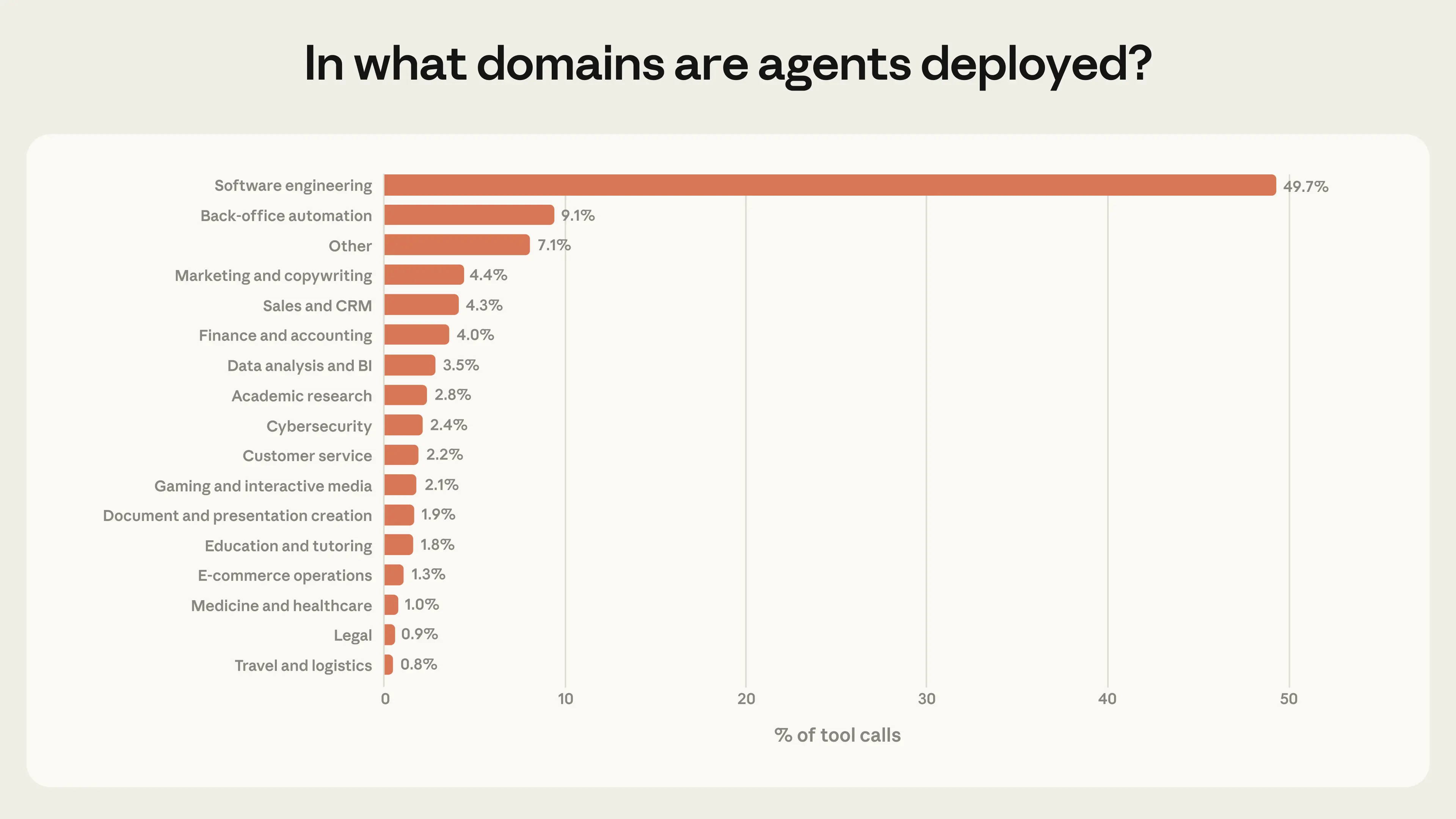
Anthropic’s agents are overwhelmingly used for coding, but is also making inroads elsewhere. (Picture: Anthropic)The AI lab has analyzed millions of human-agent interactions with Claude Code and their API. Unsurprisingly, they found most of the usage to be for coding work, with uptake in other sectors lagging far behind.
They discovered that while most of the usage is for one-shot code snippets, more users are letting Claude Code work autonomously, up to 45 minutes at a time after three months.
Whoever thought it was a good idea to have these guys hold hands? (Picture: Government of India Press Information Bureau) In what was expected to be a show of unity with Indian PM Narendra Modi on stage, AI leaders were asked to hold hands in solidarity.
Anthropic CEO Dario Amedei and OpenAI CEO Sam Altman were, however, for some reason, placed right next to each other on stage — and the acrimonious rivals promptly refused the gesture.
Models are coming at breakneck speed from Anthropic. (Picture: Anthropic)Sonnet 4.6 comes less than two weeks after Opus 4.6, and performs almost as well at the same old cost of $3/$15 per million tokens.
It features upgrades across coding, computer use, long context reasoning, agent planning, knowledge work and design, Anthropic says.
It is now the default model for the Free and Pro plans, and has a context window of 1 million tokens.
The model performs best in class for Agentic financial analysis and Office tasks on benchmarks, but it otherwise lags slightly behind Opus 4.6.
— Sonnet 4.6 offers strong performance at any thinking effort, even with extended thinking off, Anthropic writes.
Also, Claude in Excel now supports MCP connectors, so you can now import data and use everyday tools without ever leaving Excel.
Anthropic’s ad was about ads in chat responses, and it seems to have landed. (Picture: Screenshot)While the AI Super Bowl ads had generally lower engagement than others — there was a battle over mindshare brewing between them.
Anthropic won that battle, and saw a jump in daily active users of 11%, CNBC writes, quoting BNP Paribas. In comparison, ChatGPT jumped 2.7% and Gemini added 1.4%.
Anthropic also won the battle over social media engagement, with more positive posts (25.5%) after their ad was shown than OpenAI (16.3%) — even though OpenAI led with 25K posts to Anthropic’s 10K.
Measuring through Instagram, OpenAI’s ad scored a 44% positive sentiment from 3,829 engagements on its post, while Anthropic scored 41% on 3,738 mentions, far behind the likes of Pepsi’s 33K mentions.
Anthropic secures what has become a normally enormous valuation. (Picture: Anthropic)The round is the second largest tech investment in history, and puts Anthropic close to the top of the valuation range for AI labs, having grown its revenue ten times for every year the last three years.
Their current run-rate revenue sits at $14 billion, they say, well within that range.
The free tier on Claude is leveling up, getting the most popular paid features. (Picture: Anthropic)Using Sonnet 4.5, these features were previously only available on the paid tiers.
But now, Claude can create and manipulate Office files and PDFs for free.
Connectors are also available, which make it possible to link to Slack, Canva and others.
Anthropic is also making Skills free. These are saved prompts and workflows as a kind of template, that can be invoked at any time for repetitive tasks.
Finally, «Compaction» is becoming available on the free tier, which «summarizes earlier context automatically, so long conversations can continue without starting over.»
Together, these comprise «Claude’s most-used features,» Anthropic says.
Opus 4.6 should outperform most other frontier models as of now. (Picture: Anthropic)It’s a point release, but Claude just got a whole lot more capable, and now has a 1 million token context window.
It should be better at doing everyday tasks, and along with upgrades to Claude in Excel, Anthropic is also launching Claude in Powerpoint in beta with this release.
It also supports «agent teams,» letting you «spin up multiple agents that work in parallel as a team that coordinates autonomously.»
Opus 4.6 was also built by Claude, in what seems to have become an industry standard to use their own coding tools for new models. GPT-5.3-Codex was built in a similar manner.
As for benchmarks, it beats most frontier models on almost every one of them. It scores 65.4% on coding-level Terminal-Bench 2.0, and does 68.8% on the difficult ARC-AGI-2, and 53% on Humanity’s Last Exam for general reasoning.
Also new with this model is the advent of «Adaptive thinking,» which lets Claude itself decide when to use deeper reasoning, and different «Effort»-levels for each query, set by users, which could save a few tokens.